

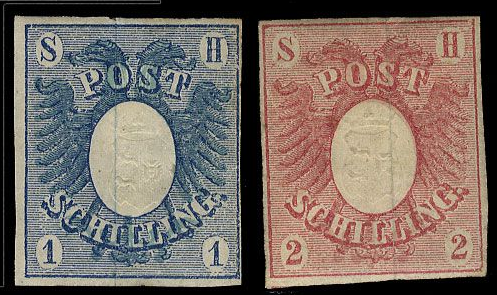
A Stamp Born from Revolution: The 1850 Schleswig-Holstein Provisional Issue
The Schleswig-Holstein 1850 Provisional Government stamp issue stands as one of the most historically charged philatelic artefacts of nineteenth-century Europe. Emerging directly from the turmoil of revolution and war, these embossed imperforate stamps capture a brief, turbulent moment when the duchies of Schleswig and Holstein attempted to forge their own political destiny, separate from Danish rule. For collectors of classic European philately, this issue represents the intersection of rare postal history and dramatic geopolitical upheaval — a combination that makes it perpetually compelling.
Historical Background: Duchies, Revolt, and the Provisional Government
To understand why these stamps exist at all, one must appreciate the complex constitutional knot that bound Schleswig and Holstein to the Danish Crown in the mid-nineteenth century. The King of Denmark held the additional title of Duke of both duchies, but the two territories had distinct legal and cultural characters. Schleswig had close ties to Denmark, while Holstein — a German-speaking duchy — was part of the German Confederation. When the Danish government moved in early 1848 to integrate Schleswig more fully into the Danish state, it sparked immediate resistance among the predominantly German population.
On 24 March 1848, a Schleswig-Holstein Provisional Government was proclaimed, setting off a three-year conflict with Denmark backed by Prussian military intervention. This short-lived administration needed its own instruments of governance — including postage stamps. Designed by M. Claudius and printed by H. W. Köbner & Lemkuhl of Altona, the resulting issue gave the provisional state its own philatelic identity. The denominations were expressed in skilling, within a currency system where 96 skilling equalled one Rigsbankdaler, reflecting the Danish monetary framework still in daily use across the duchies.
After peace was concluded in 1850, the political landscape shifted again. Danish stamps returned to circulation — from 1 May 1851 in Schleswig and from 1 July 1853 in Holstein — rendering the provisional issue obsolete. The stamps catalogued under Stanley Gibbons as numbers 2 and 4 were only ever available in Holstein and were formally withdrawn at the end of March 1851, giving them an extremely narrow window of legitimate use. [INTERNAL LINK: classic 19th-century German States philately overview]
Design and Production: Embossed Arms on Paper
The central design element of this issue is the Arms of Schleswig-Holstein, rendered in embossed relief — a technique that gives the stamps a tactile, sculptural quality rarely encountered in early philately. The embossing was produced without colour, with the heraldic device rising from the paper’s surface, while the surrounding field carries the printed colour. This combination of intaglio-style embossing and flat colour printing was a sophisticated production choice for the period, lending the stamps a dignified, official character befitting a government asserting its legitimacy.
The 1 schilling denomination appeared in shades ranging from Prussian blue through deep blue to pale blue, while the 2 schilling value was issued in pale rose and deep rose. These colour variations, though subtle, are meaningful to the specialist collector and contribute to the breadth of a focused collection built around this single issue. All values are imperforate, as was standard for the era, and there is no recorded watermark on these stamps.
Collecting the Issue: Varieties, Availability, and Condition
Assembling a complete representation of this issue is a genuine challenge, not least because of the small number of values involved and the restricted period of use. Collectors should be aware that two of the catalogue entries — numbers 1 and 5 in the Stanley Gibbons listing — were prepared but never officially issued. Their existence is a matter of philatelic record, but they cannot form part of a legitimate used collection and are handled as essays or unissued material rather than mainstream postage stamps.
For the issued values, condition is paramount. Imperforate stamps of this era are highly vulnerable to trimming, and a stamp that appears to have wide margins should always be viewed with healthy scepticism unless accompanied by a recognised certificate of genuineness. Wide, even margins on all four sides, with the embossed device complete and undamaged, represent the ideal. Used examples showing a contemporaneous cancellation from the brief period of valid use — particularly a Holstein postmark from before the end of March 1851 — carry added historical resonance and typically attract strong collector interest.
Colour shade identification is a rewarding pursuit for those who enjoy the technical side of classic philately. The distinction between Prussian blue and pale blue on the schilling values, or between pale rose and deep rose on the two-schilling, is best assessed in good natural light and by comparison with accurately described reference material. Acquiring a reputable specialist handbook on the German States is strongly recommended for anyone building a serious collection of this material. [INTERNAL LINK: guide to authenticating classic German States stamps]
Aftermath and Philatelic Legacy
The story of Schleswig and Holstein did not end with the peace of 1850. In 1863, Denmark once again attempted to annex Schleswig, triggering an invasion by Prussia and Austria on 1 February 1864. The subsequent Convention of Gastein in August 1865 divided the duchies: Holstein came under Austrian administration, while Prussia took control of Schleswig and Lauenburg. This sequence of events would produce further, equally fascinating stamp issues — each one a philatelic chapter in the long struggle over these territories. The 1850 Provisional Government issue is, in this sense, the opening page of one of philately’s most politically charged regional narratives. For the collector, owning an example is to hold a tangible piece of the revolutionary moment from which modern German and Danish national identities were partly forged.
Frequently Asked Questions
- Were all the denominations in the 1850 Schleswig-Holstein issue actually sold to the public?
- No. Two of the values listed in the Stanley Gibbons catalogue for this issue — numbers 1 and 5 — were prepared but never placed on sale. Only the stamps recorded as numbers 2, 2a, and 4 saw genuine postal use, and even those were available only in Holstein, being withdrawn at the end of March 1851.
- What should I look for when assessing condition on imperforate examples?
- Even margins on all four sides are the primary indicator, as imperforate stamps are frequently trimmed to disguise faults. The embossed central device should be crisp and undistorted. Any example with unusually large margins deserves careful examination, and a certificate from a recognised expertising body provides the most reliable assurance for higher-value items.
- Why did Danish stamps replace the Provisional Government issue after 1850?
- Following the conclusion of the Schleswig-Holstein war in 1850, Danish authority was restored over the duchies. Danish stamps were introduced in Schleswig from 1 May 1851 and in Holstein from 1 July 1853, ending the brief period during which the Provisional Government’s own stamps were in circulation.