

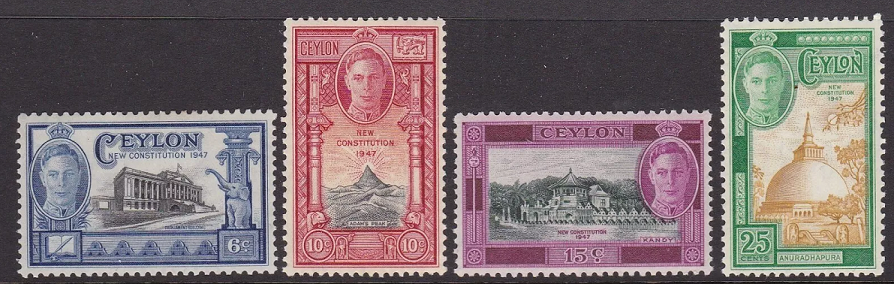
The 1947 Ceylon New Constitution commemorative stamp series mark a pivotal moment in Ceylon’s history, celebrating the introduction of a new constitution that granted greater self-governance to the island while still remaining a British Crown Colony.
Issued on November 25, 1947, this four-stamp set visually represents Ceylon’s rich cultural and political heritage, featuring important national landmarks alongside a portrait of King George VI. These stamps remain highly collectible among philatelists and historians for their symbolism, design, and significance in Ceylon’s journey toward independence.
Historical Background: The 1947 Constitution and Its Impact
- The Soulbury Constitution, introduced in 1947, laid the groundwork for Ceylon’s full independence from Britain.
- It established a parliamentary system, giving more power to elected representatives, though Britain retained control over defence and foreign affairs.
- This constitution was a precursor to full independence, which was achieved on February 4, 1948, when Ceylon officially became a Dominion of the British Commonwealth.
- The 1947 stamp issue commemorates this milestone, acknowledging the political progress and cultural identity of the island.
1947 Ceylon New Constitution Stamps: Designs and Features
This four-stamp set was designed by R. Tenison and M. S. V. Rodrigo and printed using recess engraving by Bradbury, Wilkinson & Co..
Stamp Designs and Denominations
- 6 cents (black and blue) – Parliament Building
- Depicts Ceylon’s Parliament, symbolizing the new constitutional system and democratic governance.
- 10 cents (black, orange, and carmine) – Adam’s Peak
- Features Adam’s Peak, a sacred mountain in multiple religious traditions, symbolizing unity and heritage.
- 15 cents (green and purple) – Temple of the Tooth
- Showcases the Temple of the Tooth in Kandy, the most sacred Buddhist site in Ceylon.
- 25 cents (ochre and emerald-green) – Anuradhapura
- Highlights the Ruwanwelisaya stupa in Anuradhapura, one of the oldest Buddhist monuments in Sri Lanka.
Printing and Perforation Details
- Watermark: Multiple Script CA
- Perforation:
- 11×12 (horizontal format stamps)
- 12×11 (vertical format stamps)
These meticulously designed stamps showcased Ceylon’s blend of modern governance and ancient cultural heritage, reinforcing its national identity at the dawn of independence.
Market Value and Collector Interest
The 1947 New Constitution stamp set is a sought-after commemorative issue, with collectors valuing it for its historical importance and aesthetic appeal. The estimated catalog values for mint and used conditions are:
- 6c black and blue (Parliament Building) – £0.75 mint, £0.75 used
- 10c black, orange, and carmine (Adam’s Peak) – £0.75 mint, £0.75 used
- 15c green and purple (Temple of the Tooth) – £0.75 mint, £1.25 used
- 25c ochre and emerald-green (Anuradhapura) – £0.75 mint, £2.50 used
- Complete Set of 4 – £2.75 mint, £4.00 used
- Specimen Overprint Set of 4 – £130 mint
These values highlight the affordability of standard mint and used copies, while specimen overprints remain rare and significantly more valuable.
Final Thoughts: The Legacy of the 1947 Ceylon Stamps
The Ceylon New Constitution stamps of 1947 reflect a moment of transition and national pride, capturing Ceylon’s governance, religion, and history in a single issue.
- These stamps remain a cornerstone in Sri Lankan philately, bridging the colonial past and independent future of the nation.
- The set is widely collected due to its detailed engravings, historical relevance, and connection to Sri Lanka’s independence movement.
- It represents an important milestone, setting the stage for Ceylon’s full independence in 1948.
For collectors of Ceylon/Sri Lanka stamps, British Commonwealth issues, or independence-related philately, this set is an essential addition.